

What shapes the forecasts
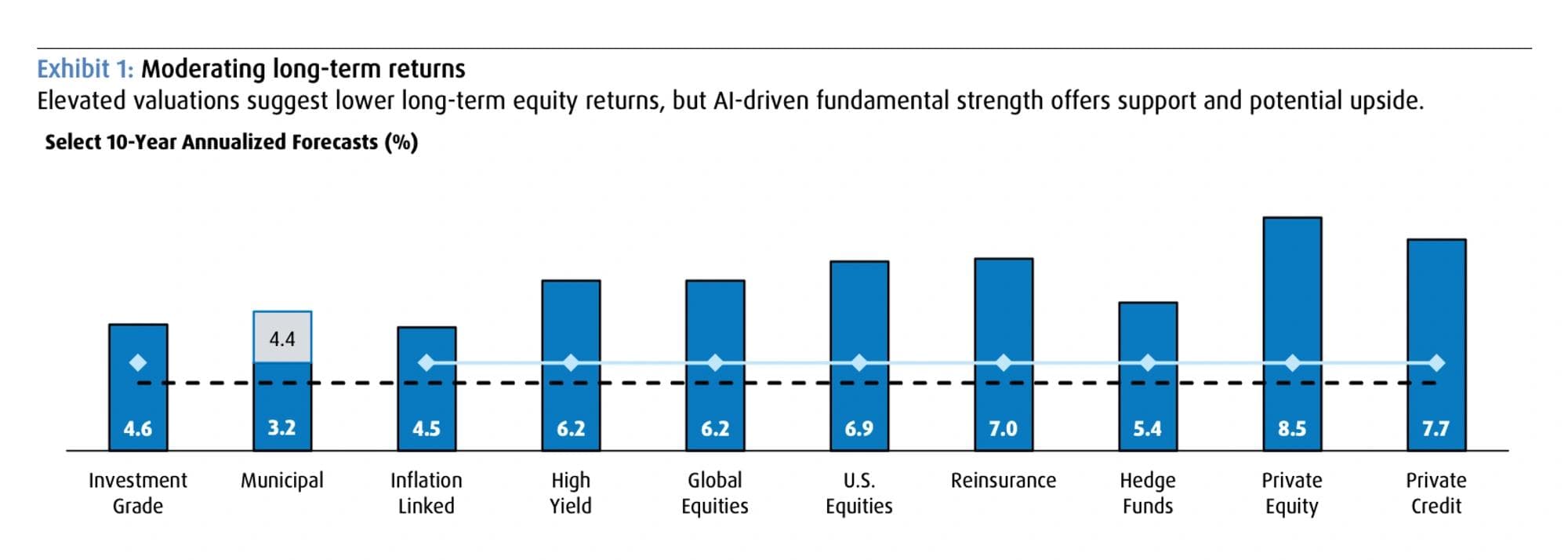
The BMO annual capital market assumptions process establishes 10-year annualized return forecasts across major asset classes, set within a backdrop of long-term macro themes. These forecasts, combined with risk and correlation assumptions, serve as the necessary inputs for investment portfolio construction and financial planning exercises. We use a “forward-looking, historically aware” approach – first seeking to identify historical relationships between asset classes and what drove past asset-class returns and then exploring how those relationships may change over our 10-year investment horizon. We express these forward-looking views through our long-term themes – covering AI’s expanding reach, elevated government debt and evolving geopolitics.
Exhibit 1: Moderating long-term returns
We believe the below long-term themes will influence asset-class returns while also offering thematic investing opportunities.
Hooked on AI
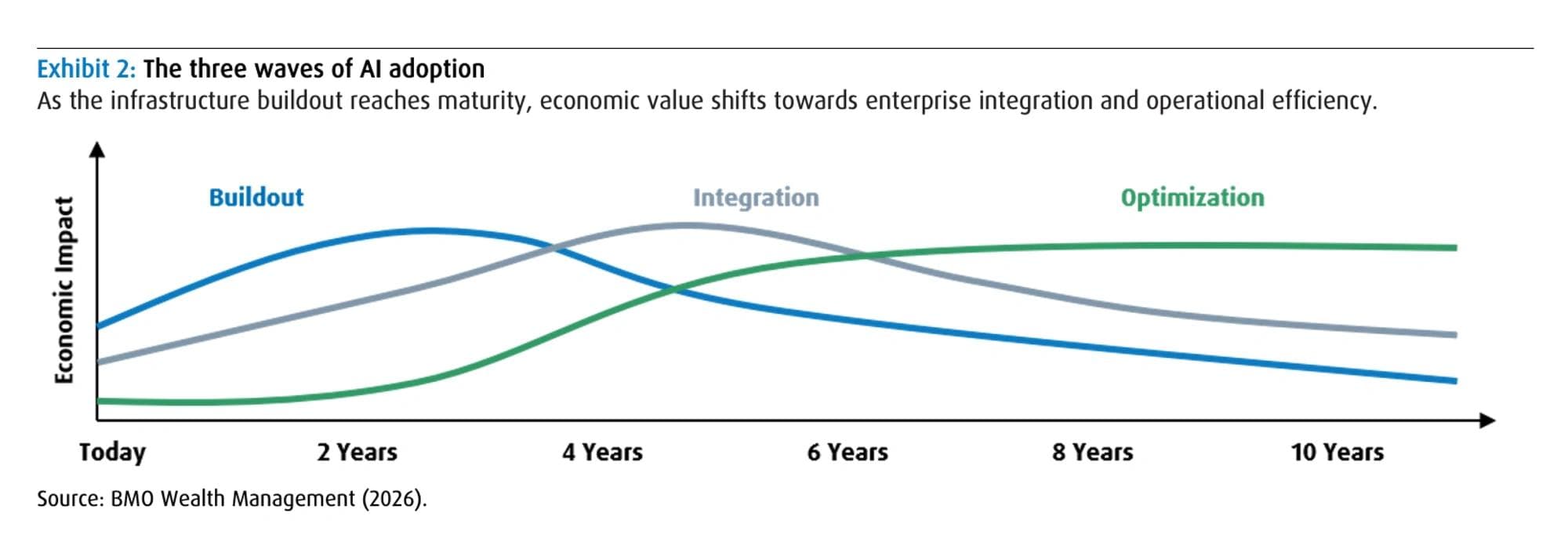
Artificial Intelligence (AI) adoption has occurred far quicker than that of previous innovations – with the global economy becoming increasingly reliant on the revolutionary technology. For investors, the question is no longer whether AI will fundamentally alter global economic functioning – instead replaced by how quickly and to what extent. We believe AI adoption will play out over our 10-year horizon and beyond, developing along three overlapping waves – Buildout (already underway); Integration (stirring, but dependent on Buildout); and Optimization (dependent on Integration and likely to extend past the next decade). As these waves rise and fall, we expect near-term economic choppiness to evolve into higher long-term growth.
"For investors, the question is no longer if AI will fundamentally alter global economic functioning, but how quickly and to what extent."
Exhibit 2: The three AI waves—Buildout, Integration and Optimization.
Read the full outlook and explore what each wave could mean for businesses, investors and the broader economy.

Economic Restructuring
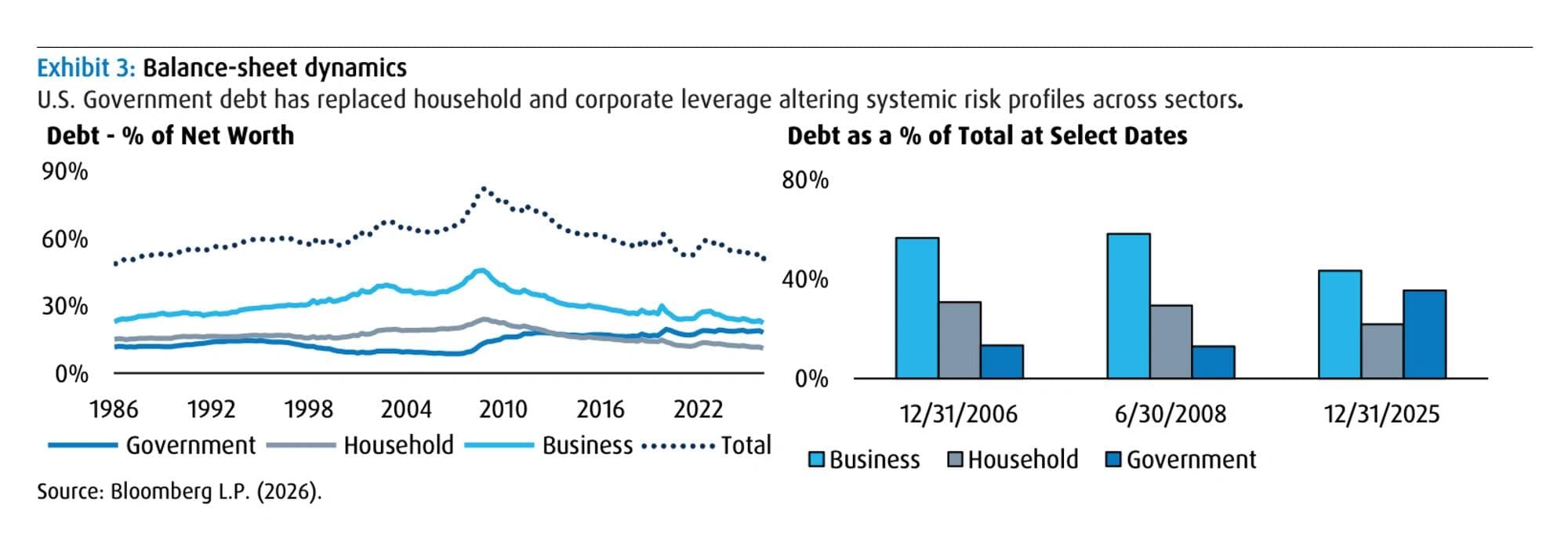
The U.S. debt problem is not necessarily its size – combined government, business and household debt relative to the country’s aggregate wealth has been falling ever since the Global Financial Crisis. Instead, the problem is its composition – simply put, the government’s share of overall debt is too big. Capital would be better used in the generally productive business sector as opposed to the often-wasteful government. Government debt reduction (even relative to the country’s ever-growing net worth) seems overly optimistic (if not unobtainable). But we believe a shift towards greater business-sector debt – aided by ample profitable projects (AI and others) – is achievable. Done right, the current debt situation could represent as much opportunity as risk.
"Done right, the current debt situation could represent as much opportunity as risk."
Exhibit 3: Balance-sheet Dynamics
Read the detailed analysis in the full report of why the changing composition of debt could create both challenges and opportunities.
Geopolitical Darwinism
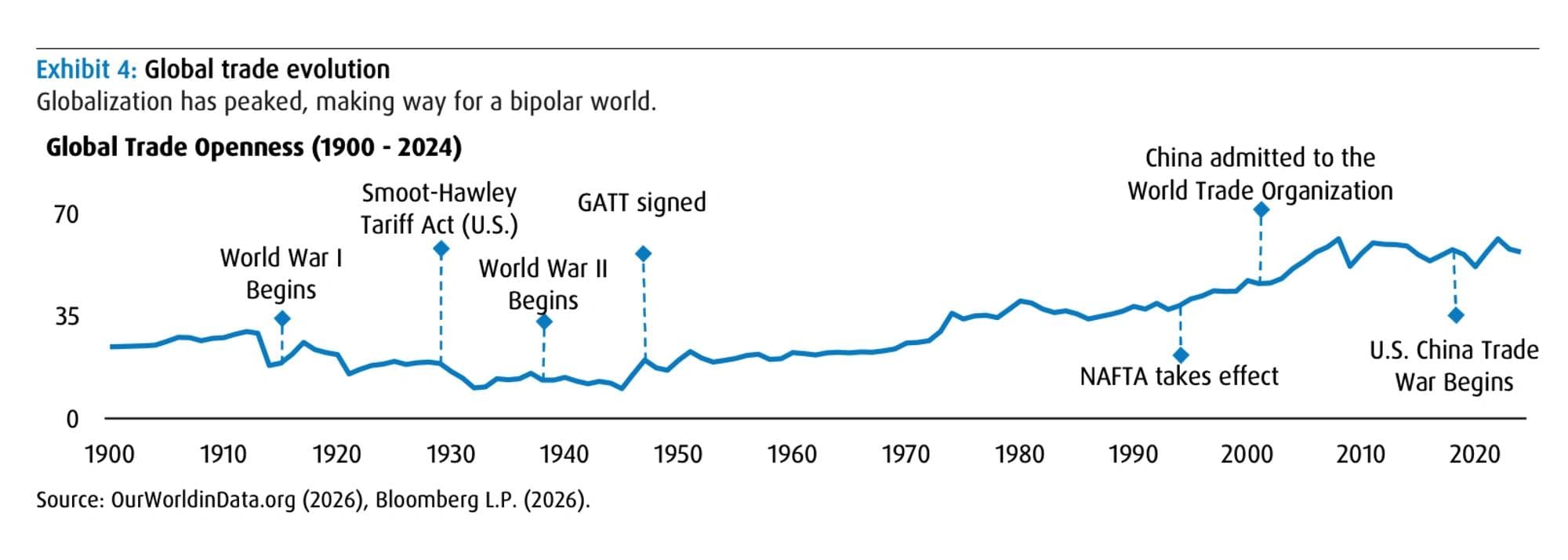
The geopolitical world order established in the aftermath of World War II and reinforced with the fall of the Berlin Wall fostered a system of global integration and rapid global economic growth. But over the past decade that system has come under assault – destabilized by forces within (e.g., growing wealth disparities) and pressured by forces acting upon it (e.g., China’s rise). What emerges will be shaped foremost by the evolving competition between the U.S. and China – and secondarily by how other economic actors adapt around them. Those in control of global choke points across natural resources, trade routes, industrial capacity and financial infrastructure will quickly find individual success – while global success will look different vis-à-vis the last seven decades.
"Over the past decade, globalization has come under assault – destabilized by forces within and pressured by forces acting upon it."
Exhibit 4: Global trade evolution
Explore the full outlook for BMO’s perspective on how countries and markets may adapt to this changing global order.
Explore the full outlook
These three themes are part of BMO’s broader 10-year outlook across fixed income, equities, diversifiers and private markets. Read the full report to explore the analysis behind the forecasts and what may shape returns in the decade ahead.

BMO 2027 Long-Term Outlook